
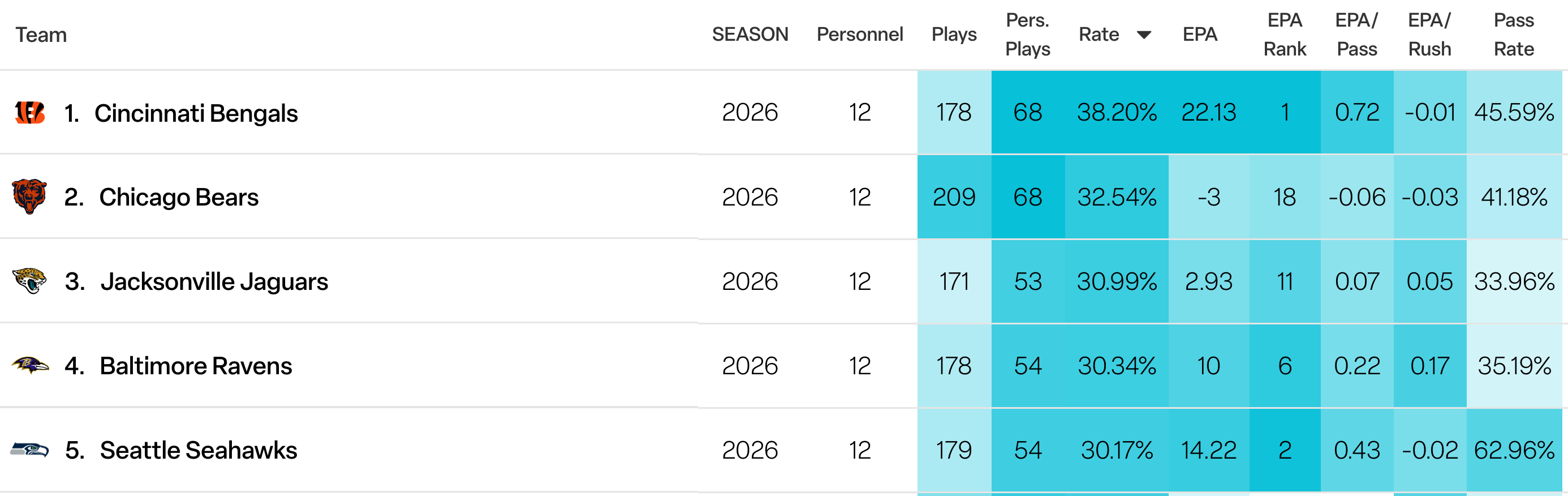
Compared to a league average of 21.3%, the Seattle Seahawks are in 12 personnel (2 TE, 1 RB, 2 WR) on 30.2% of their offensive plays so far this season, which is the fifth-highest rate in the NFL. It is still a considerable drop from last week, when Seattle was ranked first, but the Seahawks have the second-best EPA out of 12 personnel, behind only the Bengals, the team also running the highest rate of 12 per SumerSports.
Brian Fleury’s history as a tight ends coach with the San Francisco 49ers is proving to be instrumental in his tendencies as a first-year offensive coordinator.
A.J. Barner leads all of Seattle’s non-offensive linemen in snaps, even including Jaxon Smith-Njigba.
Barner had nine targets against the Moons, second-highest single-game total of his career.
Fleury’s rate of 12 is partly to blame for “underwhelming” contributions by Rashid Shaheed because putting an extra tight end on the field means subtracting a wide receiver.
Shaheed’s ideal grouping would be 11 personnel so that he could attack the third level of the defense with JSN and Cooper Kupp occupying the short and intermediate areas of the field, but he’s on the wrong offense for that:
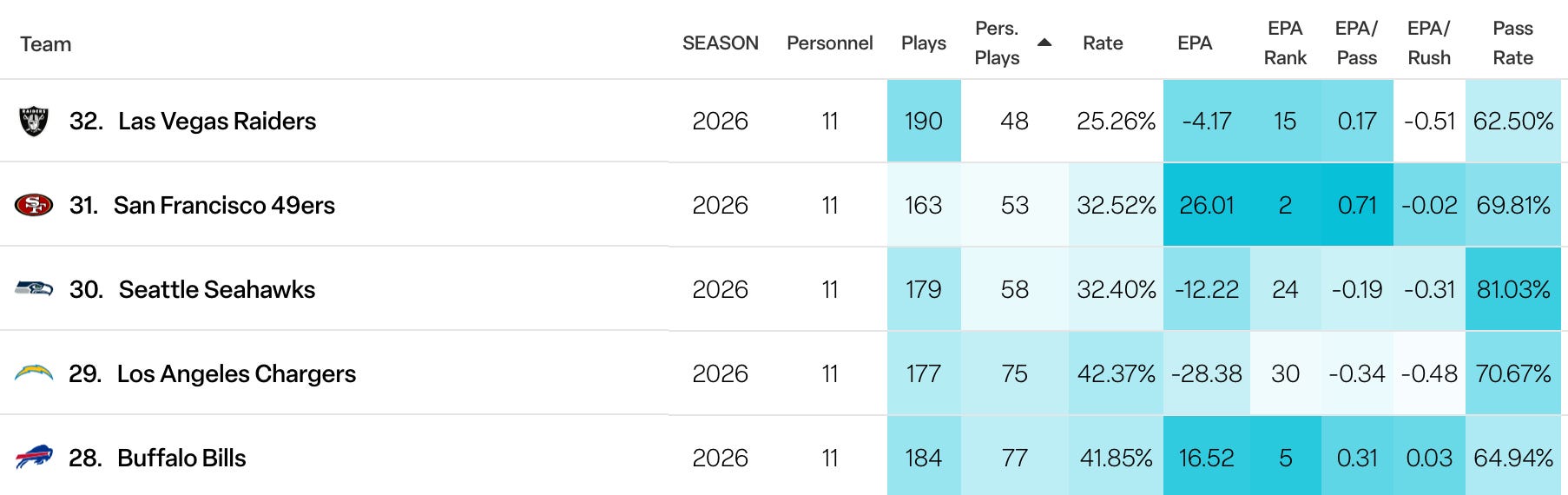
The Seahawks have the third-fewest plays in 11 personnel in the NFL at 58 total, and the rate of 32.4% is well below the league average of 56.1%.
As such, Shaheed has only played in 55% of Seattle’s offensive snaps so far, which makes it more difficult for him to get enough opportunities to give back to the Seahawks for the $51 million contract that they paid him. A 55% snap rate ranks 79th in the NFL right now, putting Shaheed in the company of guys like Chris Bell, Caleb Douglas, and AD Mitchell.
Hey, I’ve heard of ONE of those guys!
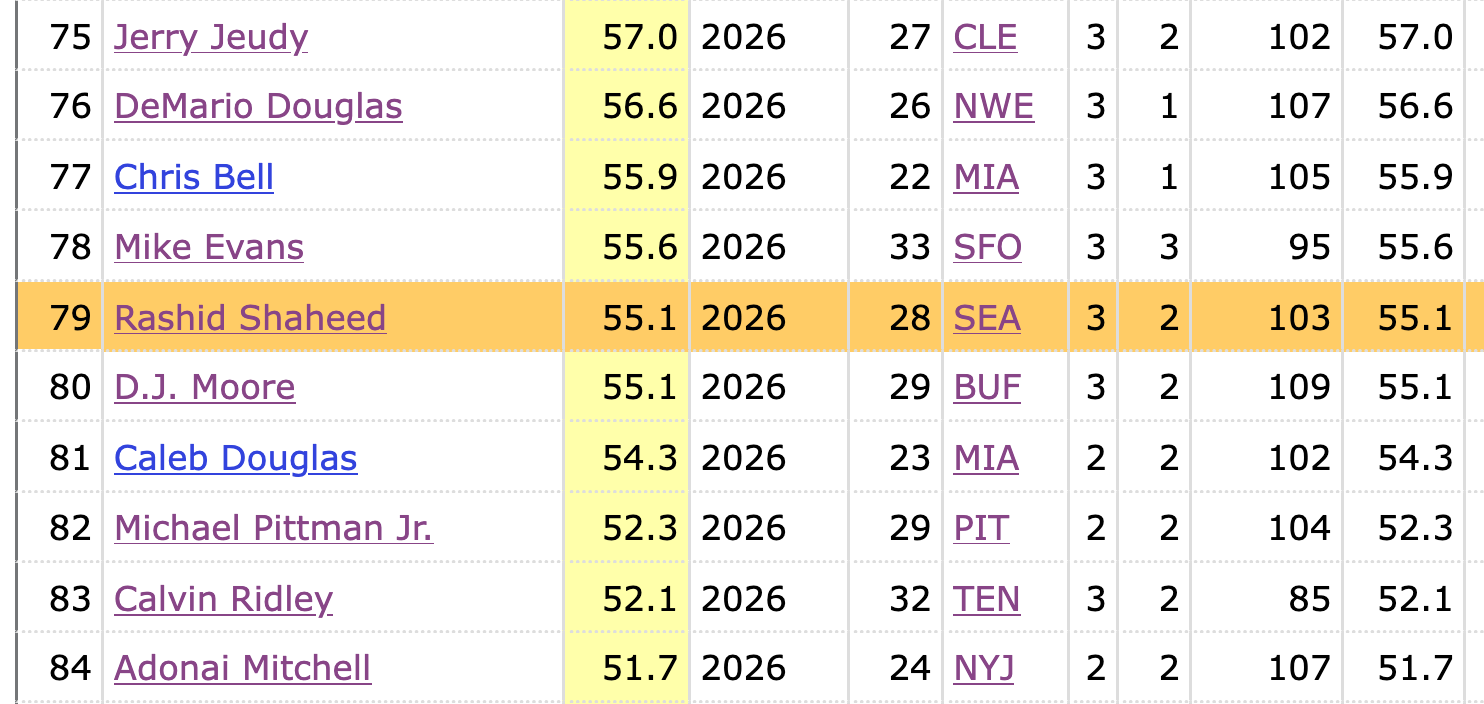
The only receivers with at least 100 snaps and under 60 yards are Shaheed, Jerry Jeudy, Jahan Dotson, Bryce Lance, and Jalen Nailor. Shaheed has only run 62 routes this season, which is tied for 88th among all players. It’s not Shaheed’s fault that the Seahawks paid him like a WR2 and now refuse to use him like a WR2, so we’re left to only speculate what this means moving forward:
—Is Seattle playing the long game and waiting to surprise teams with his inclusion in the second half of the year?
—Did John Schneider guess wrong in terms of Fleury’s tendencies as an offensive coordinator and the rate of using a third receiver?
—Or did the Seahawks simply throw money at Shaheed because he was instrumental during their Super Bowl run as a special teams asset?
I wouldn’t want to assume that Schneider misjudged a player’s value because the Seahawks became enamored with his potential as an offensive weapon after making a trade with the Saints, but …
Shaheed or Kupp?
12 personnel means two receivers, which means JSN + someone else. Cooper Kupp is slightly ahead of Shaheed in snaps, 114 to 103, and he also has more yards (101 to 53), and first down catches (6 to 1), which makes it hard for Seattle to give the older guy’s reps to the younger guy (but at 28, Shaheed isn’t that young). There’s also the matter of run blocking, where Kupp excels among all receivers in the league, and how that plays into his favoritism out of 12; and running the ball consistently is still an issue for the offense.
The playing time gap spread open a bit more in Week 3, as Kupp played 14 more snaps than Shaheed, plus Tory Horton got 15 of his own.
The TE2 snaps were evenly split between Eric Saubert and Elijah Arroyo at 18 each, and Nick Kallerup got seven. So Fleury is probably unique in another way in that the offense has seven guys who almost never come off of the field:
QB
JSN
Barner
4 out of 5 offensive linemen
The other four positions are spread apart almost unpredictably.
In Week 3, three running backs were separated by five snaps; three tight ends combined for 43 snaps; Christian Haynes and Beau Stephens split right guard snaps; Brady Russell got 12 snaps as a fullback; and then musical chairs between Kupp, Shaheed, and Horton.
If that sounds like a criticism in and of itself, it’s not intended to be. It’s just an observation and nine different Seahawks caught a pass on Sunday.
JSN is the most dominant offensive player in the NFL. Sam Darnold looked really good on Sunday, minus the turnovers, and Drew Lock preceded him in good looks. Four non-JSN players had at least 40 receiving yards (Barner, Horton, George Holani, Kupp). Shaheed and Barner’s lack of involvement prior to Week 3 were probably the only things standing out as negatives in the passing game.
It’s just a matter of Seattle’s robust spending at wide receiver not yet lining up with Fleury’s usage of wide receivers.
There are relatively few snaps with the personnel that football fans had become so accustomed to in the modern era, which is three-receiver sets with the third receiver as a “starter”. Not so in Fleury’s offense, where even the WR2 role is a shared job with no true starter.
Seahawks WR spending:
2026: $41.2 million (4th)
Cooper Kupp: $17.4 million in 2026
Jaxon Smith-Njigba: $10.3 million in 2026
Rashid Shaheed: $7 million in 2026
Kupp: $18 million in 2027
Shaheed: $16.5 million in 2027
JSN: $15.6 million in 2027
JSN: $33 million in 2028
Shaheed: $19.5 million in 2028
The math still kind of works out because Kupp could be a cap casualty or retirement in 2027, opening up $18 million on the books (but not answering “Who replaces Cooper Kupp?”). Kupp is a unique type of receiver, not anything like Horton or Shaheed.
The Seahawks are definitely committed to JSN and Shaheed in 2027. Then Shaheed will be a cap casualty candidate in 2028.
This reads like a team that intends to use all three receivers, but we just haven’t seen it yet. Maybe that will change. Seattle’s upcoming opponents probably won’t expect Fleury to throw out a lot of 11 personnel or to utilize Shaheed as a deep threat in a way that the Seahawks have yet to try.
There’s also the matter of whether or not Fleury will eventually use 12 personnel as a weapon in the passing offense too:
Elijah Arroyo was one of the only players not targeted against the Moons. Still one of Seattle’s most exciting recent draft picks, Arroyo had one target on the season, which he caught for 17 yards. But like the sock at the bottom of your closet or the Liquid IV packet that fell in between the crevice of your nicknack drawer, it could be difficult to see Arroyo behind all these other pass catchers.
Many of whom are also not being used.
It’s not a criticism until the Seahawks passing offense looks bad. It’s just an observation.
With respect to the Moons game. I thought The offense looked better with Darnold. Turnovers definitely hurt us and put the Moons in short field positions, which they converted to points.
I was down on our defense for giving up 33 points but your insight into how well the performed was useful.
I know the coaches will always analyze what happened and look for ways to improve. Our players HATE losing and will be accountable to get things cleaned up.
I hope that Fleury looks for a few more opportunities where he threatens deep to keep opposing D honest.
I really hope our secondary gets healthy soon.
I don’t care if play calling lines up with salaries. I just don’t think that way.
IMO, the Seahawks offense is running better now than at this time last year.
If we get ourselves bent out of shape because there’s a player at salary X only playing Y number of snaps…..jeesh.
I want more effective players playing more often, and less effective players playing less often. I just don’t care about salaries. I’m not the one paying them.