
'Nickel Emmanwori defense' has Seahawks one win away from 'best ever' conversation
Cody Alexander of MatchQuarters does a deep dive on Seattle's defense and what makes them elite (and where they are vulnerable)
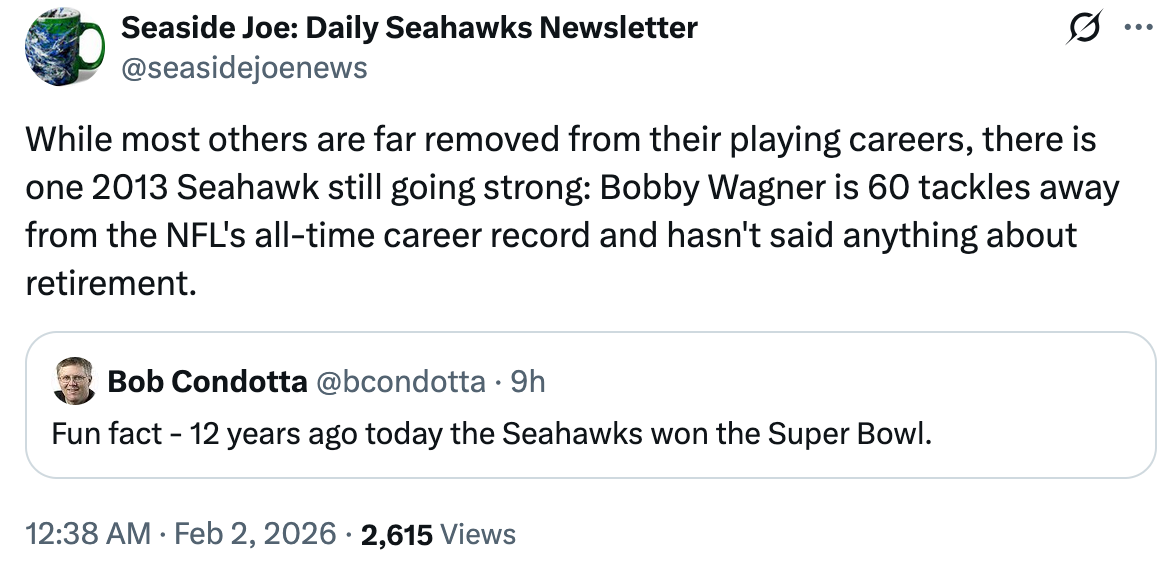
Monday is the 12-year anniversary of the 2013 Seattle Seahawks beating the Broncos in the Super Bowl so convincingly that not even Niners fans could deny that the Legion of Boom was one of the greatest defenses of all-time. Seattle’s defense that year ranked first in all the important categories and nobody was denying that it was the best at the time, but it wasn’t until late in the year and the playoffs (40 points allowed in three games) that the Seahawks were allowed to give themselves a nickname.
The 2025 Seahawks have similarly had a dominant December and January (setting aside that the L.A. Rams are the one team that is able to move the ball against Mike Macdonald) and if they beat the New England Patriots like they beat Denver 12 years ago, you might be able to call them “the Dark Side” without chuckles.
(nickname problem: the legion of boom can only refer to seattle’s defense but “the dark side” is a star wars reference first and shorthand for one of the most popular rock albums of all-time second. you’ll never be able to say “the dark side” like you can say purple people eaters or the steel curtain or legion of boom and immediately know what someone is talking about. this could be why people don’t give themselves a nickname: editorial mistakes are inevitable.)
If you are still unsure if the 2025 Seahawks could have one of the great all-time defenses before the Super Bowl, then Cody Alexander’s Super Bowl breakdown of the Seahawks and Patriots for his MatchQuarters newsletter is the type of read that will have Seattle fans cuffing themselves to radiators to avoid flying into the stratosphere because their hopes are so high.
(MatchQuarters is a wildly-popular NFL newsletter on substack about Xs and Os and analytics with 29,000 total subscribers, which is also relevant to Sunday’s bonus article about why the Seaside Joe community is so insanely engaging and supportive.)
I’m not going to give away Cody’s entire article because that’s his work and it’s a paid post (but you can use a “one free article” to read it for free) however I don’t think he would mind that I’m sharing his Seahawks post with so many Seahawks fans and plucking a few key highlights to entice you to read the entire thing.
The Seahawks defensive “identity”
Here’s Cody’s summary of what makes Macdonald’s D so good:
Identity: The Seahawks have constructed the league’s premier defense (-24.2% Overall DVOA), built on a foundation of elite fundamentals rather than schematic genius. Their identity is defined by a heavy reliance on Zone (71.7%) and Split-Safety shells (51.4%, 3rd highest), trusting their front four to generate havoc (34.2% Pressure Rate, 3rd) without needing to blitz heavily (26th in Blitz Rate). They force offenses to drive the length of the field and refuse to break.
The result is the number one Defense-adjusted Value Over Average (DVOA) rank in the NFL this season against both the pass and the run:
DVOA Rank:
Overall: -24.2% (1st)
Run: -30.1% (1st)
Pass: -20.2% (1st)
Cody emphasizes that one of the most fascinating aspects to Seattle’s defense is that they rank 32nd in base defense usage (3 linebackers, 4 defensive backs) at 6.3% and 2nd in nickel defense (2 linebackers, 5 defensive backs) at 77.3%.
The Seahawks don’t rank high or low in man or zone usage, but they do rank top-8 in EPA (expected points added) per play allowed in either man or zone. So no matter how they defended an offense, they’ve been successful.
A well-established factor for Seattle’s success in being able to stop the run despite being in nickel or dime most of of the time (Cody: “Unlike many modern defenses that sacrifice run integrity for pass coverage, the Seahawks suffocate the run primarily through discipline and elite line play, ranking 3rd in Power Success (54.0%)”) is that the Seahawks drafted Nick Emmanwori out of South Carolina with the 35th overall pick.
Although Emmanwori wouldn’t make as much sense for every defense (he would make sense in general because he’s a great football player, but most defensive coordinators would need to change what they do to get as much out of him as the Seahawks have managed) his unique 4.38 speed on a 6’3, 220 lb frame allows him to close space, cover, and tackle like few humans are able.
Cody notes that Emmanwori is “elite” in man coverage but slightly more vulnerable to attack when Seattle is in zone (which they are 71% of the time), and the same goes for Devon Witherspoon.
However, the Seahawks still rank first against WR1s in DVOA allowed this year because of Witherspoon, Tariq Woolen, and Josh Jobe’s success in coverage; 6th against WRs; and 16th against WR3s. Drake Thomas, Ernest Jones, and Julian Love have also helped in Seattle’s ranking of 4th against tight ends in the same category.
Cody adds that the Seahawks are “elite” against play action passes in 2025, which could make a difference in the Super Bowl because Drake Maye had the second-highest passer rating (131.5) and second-highest CPOE (completion percentage over expectation) on play action passes this season, including 10 touchdowns and no interceptions on those throws.
When I remove play action passes from Maye’s stats, he still looks great (second-highest passer rating, first in EPA and Y/A) but that’s one less tool in his kit to use.
Structure: They sit in MOFO (Split-Safety) 51.4% of the time. This 2-high structure allows safeties like Julian Love and Coby Bryant to keep a “cap” on the defense. They do not bite on the run fakes because they don’t have to—the front four is winning the run without safety help, especially inside.
Cody notes that the Seahawks have the third-highest rate of cover-2 (31%) in the league (each safety takes one half of the deep field) and that eliminates “shot” plays that would play directly into Love or Coby Bryant’s hands.
Again, I’m not going to give out Cody’s entire article — and his article is LENGTHY so it is worth the full read — and you can click here for it.
But Cody calls Witherspoon “elite near the box” (but surprisingly someone to attack in outside coverage), Jobe “classically aggressive”, Emmanwori “elite in man coverage” but allowing too many yards after the catch, Love “the most efficient player in the secondary”, and Woolen “feast or famine” whose aggression is costing the team too much at times.
The article goes on and on and on, so if you think I’m giving too much away…this is merely a small fraction of it.
We didn’t get into Cody’s breakdowns of the defensive line, the linebackers, the offense, or the New England Patriots!
(Great work, Cody!)
If you want to support THIS newsletter, as you probably know Seaside Joe has gone out every single day for nearly seven years. If you have been a free subscriber for a little while or you just want to support a newsletter about your favorite NFL team that just won’t quit, join Regular Joes ($5/month or only $55/year) or Super Joes today:
A couple other matchup highlights:
Strength on Strength: The Patriots’ #1 Ranked Passing Offense (44.2% DVOA) faces the Seahawks’ #1 Ranked Pass Defense (-20.2% DVOA). This is the deciding matchup.
I recall that back in Super Bowl 48, I was so confident in Seattle’s pass defense that I predicted MVP Peyton Manning would have about 200 yards, 1 TD, 2 INT. There’s plenty I’m wrong about but that’s one I remember because I like betting on a pass defense over betting on a passer.
Will Maye’s impressive season (with a very underwhelming supporting cast no less) be any match for the impressive season of an entire defense?
The Run Game X-Factor: Seattle has a functional run game (Walker) to attack New England’s “soft” run defense (17th Run DVOA). New England has little run game (-6.9% DVOA) to attack Seattle’s “Wall” (#1 Run Defense). The Patriots will likely try to take advantage of the Seahawks’ reliance on their Nickel package. The problem with that is that every team has tried to win that matchup to no avail. Can the Patriots ugly this game up enough to stay in it?
Can the Seahawks lose if they hold the Patriots under 17 points? I’m not sure about that. Something that I haven’t seen Cody Alexander get into: How many points the Seahawks add on SPECIAL TEAMS.
How much of a factor does Rashid Shaheed or Michael Dickson or Jason Myers or Jay Harbaugh play in giving Seattle an extra 3 points or 6 points or 7 points? It could be significant given that this is the Super Bowl and we’ve all seen a special teams play be the difference in a huge game like this (as we’ve seen from Seattle during the season and the playoffs) and the Seahawks are the most valuable special teams team in the league.
The Seahawks are less than a week away now from proving if the Dark Side can eat the Evil Empire or not. (See how this analogy can get really confusing really fast?)
Regarding Special Teams, it’s not just the obvious points from returns and field goals, it’s hidden yards of field position.
Consider when a team is pinned behind their 20. This shortens their playbook. They don’t want plays that can turn into picks 6, so they might avoid short passes to the flat. They don’t want sacks, which can lead to scoops and scores, so they might not plan on long- developing plays. You can plan on a high run percentage.
Conversely, if we start at the 35, our whole playbook is open and we might need two fewer 1st downs to score.
Get near midfield, and our punt can suffocate the opposition. Stop them in the shadow of their goalposts, and their punter will feel the pressure, possibly giving us a short field.
Hidden yards were a big reason we beat the Rams. I haven’t finished my analysis, but it looks like we have a similar advantage over the Pats.
When a team says, “I can’t believe we lost”, or, “How was that game so close?”, there were probably hidden yards involved.
Only 147 1/2 hours til kickoff (as of this writing) but who’s counting.