Why NFL teams don't front-load contracts
Dexter Lawrence's trade request clears up why teams like the Seahawks don't set themselves up for contractual failure
Dexter Lawrence’s trade request from the New York Giants is why teams don’t front-load contracts (put more money at the beginning of the deal than in the latter years) and why the Seahawks prefer shorter three year contracts with few exceptions …
Jaxon Smith-Njigba’s four-year contract gets more lucrative with each successive season.
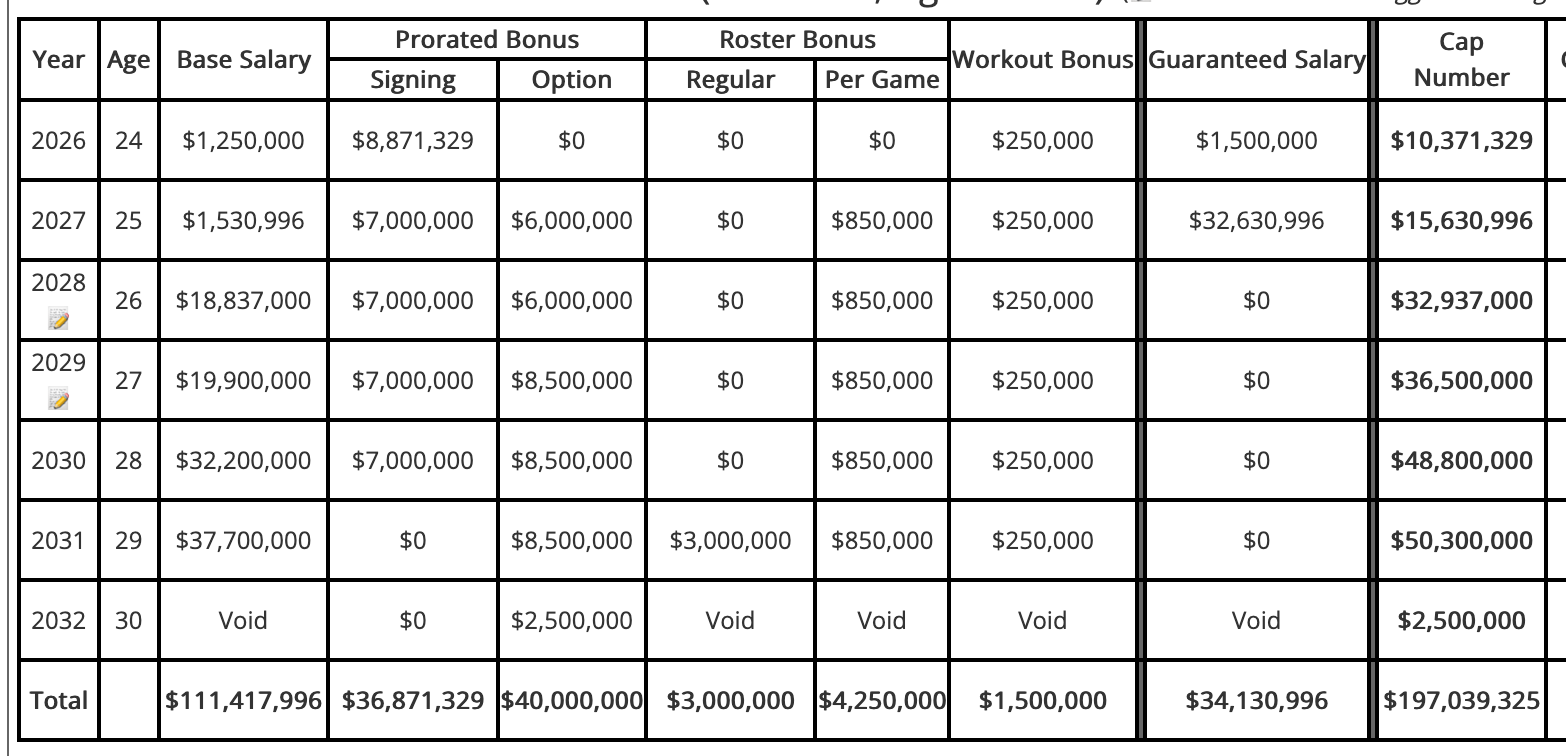
It’s more likely that JSN would say “don’t cut me” than “trade me” in 2031.
This is like the 1995 “Must-See TV” lineup on NBC: They didn’t put both Friends and Seinfeld in the 8 PM hour together, they put Friends on at 8 Seinfeld on at 9 so that the network could slot The Single Guy at 8:30 and Caroline in the City at 9:30 before ER and hope you watch all 5 shows.
I recently saw a tweet that went along the lines of “Just front-load the contract” in response to how the Seattle Seahawks should take advantage of the cap space they have right now with so many future obligations like Devon Witherspoon, Byron Murphy, A.J. Barner on the line, plus pending extensions that could happen for veterans like Sam Darnold and Leonard Williams.
Dexter Lawrence is why you don’t front-load the contract.
Lawrence’s contract pays him an average of $18.25 million per season over the next two years, not including potential bonuses. Lawrence’s AAV is $22.5 million, meaning that he would make less over the final two years of his contract than the overall average of the contract he signed in 2023.
Significantly less.
Between Milton Williams, Zach Allen, and Jordan Davis, other teams have set the market at $25.5-$26 million per season for the top non-Chris Jones defensive tackles in the NFL. Lawrence is either in that category and deserves $26 million per season or he’s better than Jones, a player who makes $31.75 million.
Lawrence, 28, could be the best defensive tackle in the NFL. Can you imagine a defensive line with Lawrence, his former Giants teammate Leonard Williams, and Murphy?
Although I can’t say that Lawrence’s four-year, $90 million contract is traditionally “front-loaded” (his cap hit still goes up by the year), he makes a lower base salary in the final season of the contract than the one before it and it is structured in such a way that he’s making less than the AAV.
If there was a way for the contract to pay Lawrence a guaranteed $25 million in 2026 or 2027, the Giants could tell him, “You’re already making the market value.”
Instead it’s pretty simple for Lawrence to compare his contract over the next two years to J Davis and M Williams and scratch his head over the difference when he’s been far more impactful and still two years shy of 30. From 2022-2024, at least one site tallied Lawrence having four times as many pressures as any other nose tackle in the NFL.
There’s a level of interior pressure and disruption that comes with Lawrence, not to mention two-gapping run defense, that teams don’t get from any other nose tackle.
He’s taking that argument out onto the market two years before his contract expires and someone, whether that’s the Giants or someone else, is going to appease his demand for a new deal. Two different New York insiders have said that the trade offers will come in around a borderline first/second round pick:
The Seahawks do have a 32nd overall pick and a history with taking elite defensive linemen off of the Giants defense and making them better.
Should John Schneider and Mike Macdonald be seriously considering flipping pick 32 for an elite nose tackle who is ready to go over a 22 or 23-year old prospect who under most circumstances will probably be someone that Schneider has a true “second round grade” on being that late in the first round?
In one hand is the Nick Emmanwori that the Seahawks got at pick 35 and in the other hand is L.J. Collier who the Seahawks got at pick 29.
Seattle could also be considering that their best deal is trading down in the first round to increase their total number of picks in a four-player class, but this is merely theoretical until the Seahawks get to 32 and then they just have to pray that anybody wants to move up. It’s a gamble to expect to trade down when nobody has any idea if there will be a team ready to tango.
And if it feels like it’s “too late” to trade a first round pick for a player who has already spent seven years in the NFL, I’m reminded of the 49ers trading for 32-year-old Trent Williams and that felt “too late” but he’s made four All-Pro teams in six seasons.
Leonard Williams spent 9.5 years in the league before he got to Seattle and he just helped the Seahawks win the Super Bowl and he’s due another extension soon.
Speaking of which, can the Seahawks even afford Lawrence?
With the lowest amount of dead cap space in the league and barely $3 million needed to commit to the rookie class (trading their first pick would basically eliminate the need to pay a rookie class on the salary cap), Seattle has $29.7 million in effective cap space. If they trade the first round pick, that would be over $31 million in cap space, the fourth-most in the league.
Seattle’s cap commitments will go up significantly in 2027 because of players like JSN, Witherspoon, Murphy, and others, but they will also be shedding cap space: Cooper Kupp, DeMarcus Lawrence, Jarran Reed, and so forth.
In fact, the probability that this could be the final career seasons for Lawrence and Reed shines an even brighter light on the uncertain future of the Seahawks defensive line.
That doesn’t mean Seattle should trade a first round pick for Lawrence (and maybe they could get something done with a 2026 second, a player, and another pick), it just means that a defensive team has to be considering what their best moves are in the draft for the future of their defensive line. That could be a rookie prospect. It could mean something else.
But if the Seahawks were to trade for Lawrence, it would mean extending him to a new contract, giving him the market price for a defensive tackle of his caliber, and not paying him more now under the impression that he’s going to be happy making less later. Nobody — in any industry — wants to take a pay cut, even if it’s not a pay cut. It just has to look like one.
Now if the Seahawks can somehow add a player who soaks up double-teams away from Murphy, Williams, Lawrence, and Uchenna Nwosu? That’s what I’d call


