
He tracks every Seahawks draft visit: 'This year feels different'
Alexandre Castro talks "30 visits', prospects at CB, EDGE, and RB, and why Anthony Bradford will be the starter again
One of the most underrated steps that the Seahawks go through every year is “30 visits” the 30 allotted meetings that they can have with prospects before the draft, but it’s not just the interviews themselves that should pique our interests. What about the process that John Schneider’s team goes through to pick which 30 players they need to have a meeting with and which ones they don’t?
That’s the wall I’d like to be a fly on.
As I was writing about Seattle’s 30 visits recently, it reminded me that my job is made that much easier because of Alexandre Castro, a writer at Field Gulls who is second-to-nobody at finding reports of Seahawks visits on Twitter and relaying that news to the rest of us.
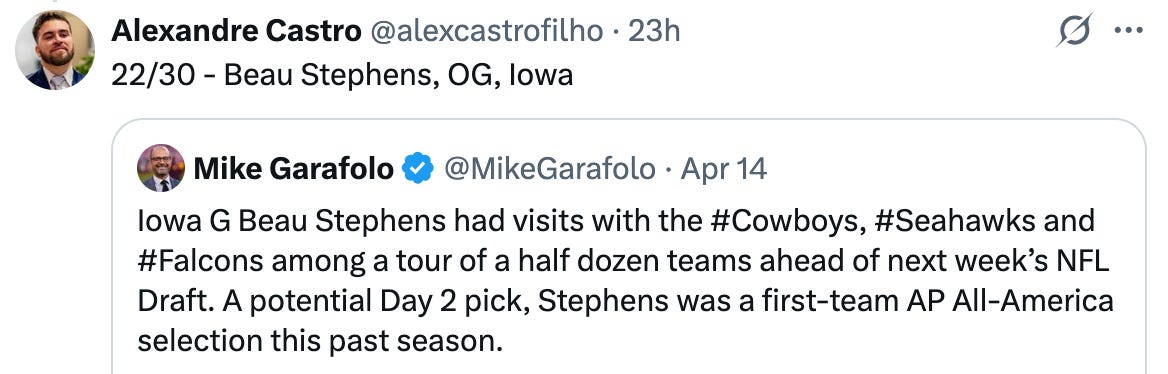
From interviewing prospects who Seattle has met with like running back Coleman Bennett to his top-10 linebackers in the draft, Alexandre does an excellent job of covering who could become Seahawks in the future.
So I asked Alexandre five questions about the draft and Seattle’s pre-draft visits in 2026.
Seaside Joe thoughts on Alexandre’s answers:
All of Alexandre’s answers sparked my curiosity for further research, but rather than interrupt with my interjections here I will post my reactions in a separate bonus article for Regular Joes that you can read here as a companion piece after this one.
Q: How long have you been tracking Seattle’s pre-draft visits and have you noticed any differences this year compared to the past, and/or from the Pete Carroll era to the John Schneider era?
AC: I’ve been tracking the Seahawks’ visits for about five years, and there wasn’t a major change from Pete Carroll to Mike Macdonald early on—maybe just more focus on top prospects. But this year feels different. In the past, they grouped most visits into one or two days, making them easier to track through social media. Now, they still brought in a large group (like they did last week), but they’ve also scheduled more individual visits.
Previously, those individual visits were usually reserved for first-round prospects with red flags, injury questions, like Jalen Carter. This year, though, they’ve used them on lower-ranked players like Brandon Cleveland (monday) and Mike Washington (tuesday), which suggests a shift in their approach.
Why Schneider chooses to meet with some prospects and not others is the key to understanding which players are more likely to be drafted by the Seahawks and which ones could be coming off of their board, like Carter presumably did.
But are they not concerned with character concerns or do we just not know anymore who has character concerns? I’ll look into that in my follow-up article.
Q: You’ve done a great job of watching and posting film on Seattle’s offensive linemen in recent seasons, especially as it pertains to the guards, and you’re very fair in your analysis. You’re brave enough to say when Grey Zabel messes up, and even braver when you find moments to praise Anthony Bradford.
The Seahawks have shown barely any interest in guards in the pre-draft process, do you think that’s an indication of their intentions and do you believe Bradford will be the starter at right guard again?
AC: I strongly believe Anthony Bradford will be the Week 1 starter unless he gets injured, even if that’s not what most Seahawks fans want. The team already gave him a chance last offseason coming off a poor, penalty-filled, injury-affected year. This season, he reduced the penalties and showed some improvement—still inconsistent, but with a few solid reps. Because of that, I don’t think the Seahawks will be desperate to replace him. That said, he’s in a contract year, so I wouldn’t rule out drafting a guard early. A key factor, though, is the strength of the class—by the time they pick, the best options to immediately replace him might already be gone, leaving them to add more depth instead.
Do I agree with this? I do. Alexandre makes a great point: The Seahawks have increased Bradford’s playing time with each successive season, so why make a change now after investing this much time into him and knowing what they’ve got going into 2026?
In the bonus article, I’d like to focus on just how raw Bradford was as a draft prospect in 2023 and the strides he’s made since then.
Q: If you had to guess, are there any visits that stand out to you in particular as far as “I think this is a prospect they really love and want to draft” or is it just a crapshoot?
AC: Two guys I’m really high on—and honestly a bit torn between—are Jalon Kilgore and Treydan Stukes, who I actually interviewed. Both are extremely versatile, with the ability to play outside, in the nickel, and at safety. I think Kilgore is a bit more versatile and really fits that “dark side” defensive mentality. He’s one of the prospects that feels the most like a Seahawks-type player in this draft—athletic, flexible, and with room to develop in areas that I believe Mike Macdonald could maximize. So overall, I’d go with both, but especially Kilgore.
Kilgore is Dane Brugler’s 88th overall prospect and eighth-ranked safety. He is also the youngest safety in the entire class. One of our Seasiders Jake mentioned Kilgore recently and I highlighted his resume in this article.
Here’s a film breakdown of Kilgore:
Stukes is Dane’s 56th overall prospect and coincidentally his eighth-ranked cornerback.
It’s almost poetic that Stukes is also the oldest cornerback in the class, as he was born on September 11, 2001. So Alexandre picked the youngest safety and the oldest cornerback; no ageism in that answer.
Stukes ran a 4.33 40-yard dash, fastest for any cornerback who is sure to be drafted. Some of the late/undrafted guys were a tick faster.
If Seattle had twice as many picks on day two than their currently total (two) then maybe they could draft both a safety and a cornerback. But without that, Alexandre is right in that the Seahawks probably have to settle for one or the other and potentially neither. If it’s one, cornerback would be the obvious choice.
Get a paid subscription to Seaside Joe for a Seahawks fan you know!
Q: The majority of visits have focused on Cornerbacks and Edges, to nobody’s surprise. Give Seahawks fans one name at both positions who you believe fits Seattle’s identity and could be available at 32 and 64.
I’m going to split up Alexandre’s answer into two parts.
AC: At cornerback, I think Chris Johnson is a great option. His range is a bit uncertain—you see him projected as high as 22, but sometimes falling to 42—so it really depends on where he ends up. He’s a strong fit for Seattle: comfortable in zone, and he showed real character by choosing to stay at San Diego State instead of transferring, honoring his commitment—similar to what Grey Zabel did last year at North Dakota State. That kind of profile could definitely appeal to the team.
At 64, one name that really fits the Seahawks’ identity—though they might not actually draft him—is D’Angelo Ponds from Indiana. He’s basically a Devon Witherspoon-type player: undersized, but extremely aggressive, active in run support, used as a blitzer, and capable of playing both outside and in the nickel. He brings that “dark side” mentality as much as anyone in this class. The main concern might be that he overlaps too much with Witherspoon, especially when the team may need bigger corners for depth after losing Riq Woolen. Still, from a mindset and stylistic standpoint, he fits perfectly with what Mike Macdonald wants on defense.
There have been some mixed messages on whether or not Johnson met with Seattle during pre-draft visits.
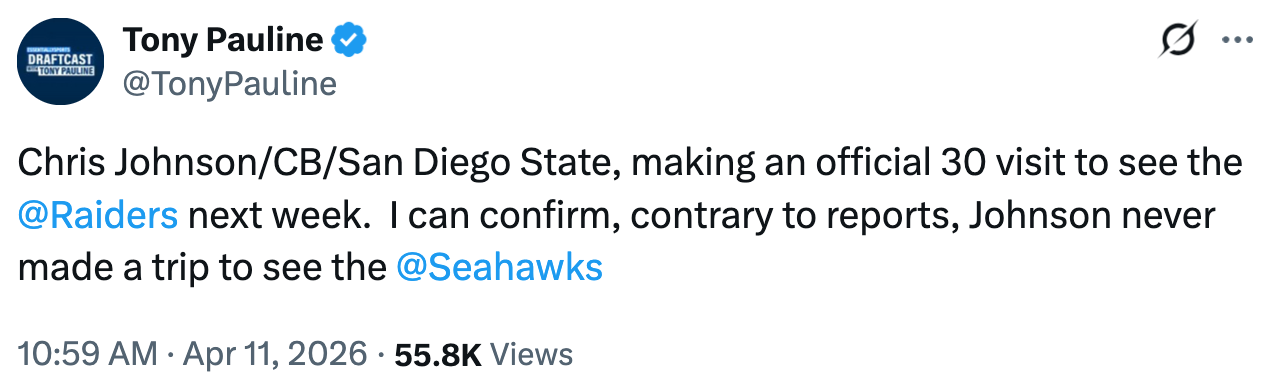
Even if he didn’t, it wouldn’t have any bearing on the likelihood that the Seahawks want to draft Johnson. If they’ve got nothing to check, they’ve got no reason to show interest in Johnson.
How big are Seattle’s needs in the secondary? I’ll address that in the bonus article too, including why Ponds would be your immediate favorite rookie.
AC: For edge defenders, one name to watch at 32—who I didn’t think would be available before, but now might be—is Cashius Howell. He was once projected near the top of the first round, but his shorter arm length has pushed him down boards. It’s still unclear where he’ll land, but I think he stays in the first round, likely toward the back end. Even with that limitation, he’s productive and holds up well against the run. Mike Macdonald has worked with similar profiles in Baltimore, so at 32, the risk is much more reasonable. He also brings that Seahawks defensive mentality.
At 64, I’d mention Malachi Lawrence. He’s another prospect with a wide range projection—some see him as a near lock for the first round, others much lower—so it really comes down to projection and upside. He’s one of the few players, along with Howell, to run a 1.50 10-yard split at the Combine, which highlights the explosiveness Seattle looks for (quick wins). That kind of speed makes him a very appealing option as well.
This draft is interesting for just how split most people are on most prospects.
Alexandre is right in that some people would have Howell way above Lawrence. However, Dane Brugler has Lawrence ranked above Howell. These guys could be choices at 32 and 64 or vice versa.
So these team boards are very personal this year and maybe getting Lawrence at 64 will be Seattle’s preference to drafting an edge rusher at 32.
Q: Emmett Johnson, Jonah Coleman, and Mike Washington appear to be the three backs that Seattle has had contact with so far who could be picked as early as the second round. Do you think the Seahawks are open to other backs, Jadarian Price for example, or could they really be narrowing their focus to one of these three and who would you pick?
AC: I think the Seahawks have done an excellent job scouting running backs. While there’s no confirmed report that they met with Jadarian Price, it wouldn’t be surprising—they were very active, even speaking with Notre Dame’s running backs coach at the Pro Day. Price is someone we’ve seen mocked to Seattle at 32, though his fumble issues and limited role in the passing game raise some concerns. That might push him down—he could even be available at 64, depending on how teams evaluate those weaknesses. Still, he’s a very talented player.
Beyond him, the Seahawks have looked at several other options like Jonah Coleman and Mike Washington, who could be available in the second or third round. Then there are later-round or even undrafted possibilities like Coleman Bennett (Kennesaw State), Chip Trayanum (Toledo) both 30 visits. Overall, it’s clear Seattle is preparing for every scenario—whether that’s a first-round back like Price or options later in the draft depending on how the board falls.
Mel Kiper mocked Price to the Seahawks in the first round on Wednesday. And Daniel Jeremiah said that the ceiling and the floor for Price is the Seahawks at pick 32.
When that many of the most famous mock drafters are mocking a certain player to Seattle, it feels guaranteed that it won’t happen.
As Alexandre notes, the Seahawks are clearly meeting with some of the top running backs and also doing their homework on Price, expected to be the best of the remaining backs behind top-ranked Jeremiyah Love. However, they’re just as prepared to know who they’d be getting if they wait until after the draft to add a rookie.
Seattle’s “shotgun” approach to the running back class makes their intentions highly unpredictable.
What are your thoughts on Alexandre’s thoughts? Do you have any more questions about Seattle’s visits that I’ve missed?
Price's clips look very good. Fast, although not Walker fast. Good size, vision and juke. Tempting. Although his apparent ball security issues, and the Hawks' history, suggest this particular guy might not be the pick unless he drops into Round 2....
If Cassius Howell is there at 32, I think they take him.
Edge is a higher valued, harder to fill position than CB or RB.
With Mafe gone, and Nwosu and D-law both nearing the end of the line, adding quality pieces and youth to the Edge room is incredibly important.
All of the above subject to be proven. entirely wrong!!