
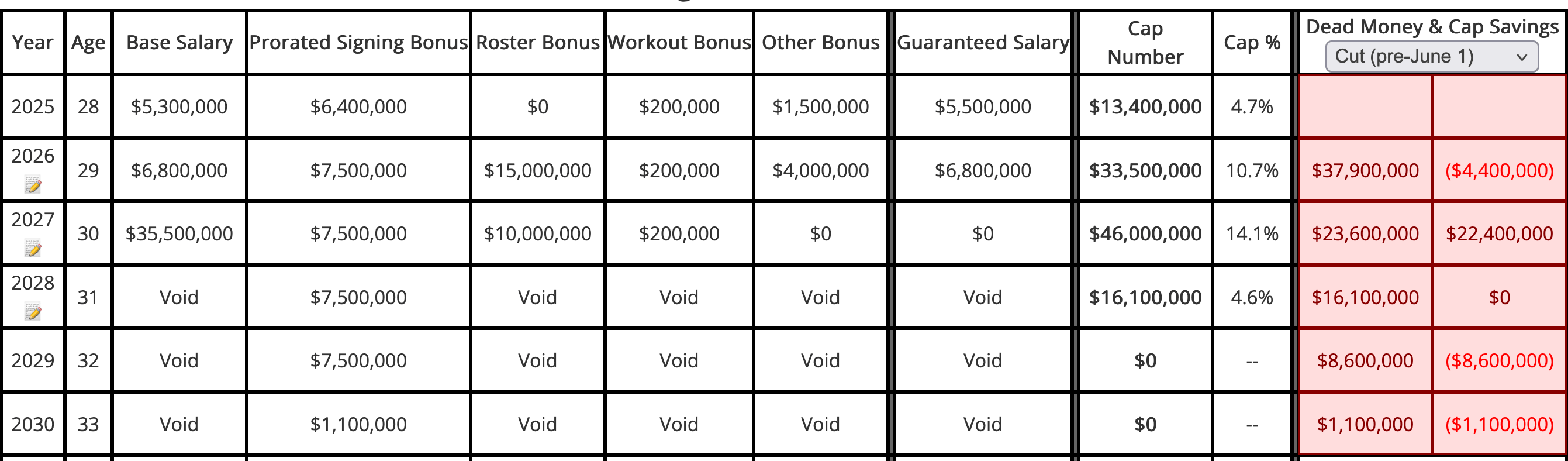
The Seattle Seahawks just made it a little less likely that Sam Darnold will lose the starting job to Drew Lock. On Friday, the Seahawks converted $5.5 million of Darnold’s 2026 salary into a signing bonus and added a void year in 2030 to spread out the cap hit even thinner.
Seattle went on a cap-finding spree on Friday, also restructuring the contracts of Julian Love and Ernest Jones and creating $9.87 million worth of 2026 cap space. Nobody outside of the organization knows yet why the Seahawks did this — you can speculate in the comments — but all three players should feel slightly more confident that the team likes them and wants to have them beyond this season and next season.

Darnold’s cap change
I just wrote about Darnold’s cap situation — and the entire Seahawks 2027 cap situation — a couple of days ago and at the time Seattle would have $19.2 million in dead cap space in 2027 if he gets traded or released. Now that number if $22.4 million. It’s not a wild change, but for the Seahawks to touch Darnold’s contract at all when they don’t appear desperate for cap space is more than doing nothing.
The Seahawks could have created just as much cap space by restructuring Cooper Kupp’s contract instead and they didn’t do that. Why didn’t they touch Kupp’s contract? Because they don’t see Kupp sticking around?
How do contracts/restructures work?
A “restructure” = taking a portion of a player’s base salary (same as any normal base salary at any salaried job) and converting it into a signing bonus that pays the player upfront instead of in weekly checks. The Seahawks took the money that Darnold was owed over the rest of the 2026 season and paid it all to him today in order to create more current cap space.
A player’s “salary cap hit” is their current year base salary + any bonuses. In order to absorb bonus money on the cap, team’s spread it out over multiple seasons with a maximum allowed of five seasons. Simply put:
Player A signs a 2-year, $20 million contract
Player A’s contract contains $12 million salary + $8 million signing bonus
Player A’s salary is $5 million in year 1, $7 million in year 2
Player A’s signing bonus is spread: $4 million in year 1, $4 million in year 2
Player A’s cap hit is $9 million in year 1, $11 million in year 2
If the team couldn’t afford Player A’s cap hit, they could add 2 void years, meaning that instead of it being $4 million per year, it’s $2 million per year, including the two years after Player A’s contract actually expires. Therefore Player A’s cap hits are: $7 million, $9 million, $2 million, $2 million.
If Player A is cut or traded before year 2 and his salary is not guaranteed, the team saves $7 million in salary but the remaining bonuses ($2 million+$2 million+$2 million) all accelerate to that year and leaves $6 million owed against that year’s cap by that team. So a $9 million cap hit would become $6 million in deap cap (the bonus money) and only $3 million in cap savings.
If anyone wants to take a crack at explaining it better than me:
How does this impact Darnold, Love, Jones?
By converting $5.5 million of Darnold’s salary into a bonus and adding a void year, Seattle added $1.1 million to their cap from 2026-2030. That’s why you see the “$1.1 million in 2030” on his cap sheet. If Darnold is traded or released in 2027, then all four $1.1 million cap hits accelerate to Seattle’s 2027 cap table and become $4.4 million. This is of course on top of the bonus money that Darnold received in 2025 when the Seahawks signed him:
Darnold received a $32 million signing bonus
Darnold had 2 void years on top of 3 contract years
$32 million / 5 years = $6.4 million per year
$6.4 million + $1.1 million = $7.5 million
That is why Darnold’s current “prorated bonus” is $7.5 million. If the Seahawks simply let Darnold’s contract run out after 2027, they will then incur a $16.1 million cap hit in 2028 ($7.5x2+$1.1) and it’ll be done with.
This is a detailed way of saying that the Seahawks are at least not acting like a team that is in a hurry to get rid of Sam Darnold.

In fact, if you had to choose today’s news as a sign that Darnold’s future with the Seahawks had “no change” or “indicated an extension next year”, the answer would have to be “indicated an extension”.
I’m not saying this indicates an extension! What I am saying is that it is closer to commitment news than it is to being no news. In the same way that converting the salaries of Ernest Jones and Julian Love indicates that the Seahawks continue to believe in them as long-term stalwarts on defense: Jones and Love are also set to become free agents in 2028, same as Darnold, and no Seahawks fans are divided on their value to the team moving forward.

Darnold is still owed $45.7 million in 2027 — $35.5 million salary (non-guaranteed), $10 million roster bonus, and $200,000 workout bonus — and that’s a lot of money for anybody, even a quarterback. This salary conversion does not guarantee that the Seahawks will keep Darnold!
However, releasing/trading Darnold and re-signing Drew Lock might not actually save the team ANY cap space. I touched on that this week too: Darnold’s dead money and the money needed to pay Lock could create the same cap hit — if not more — for Seattle to pay its quarterback room than simply extending Darnold and letting Lock leave in free agency.
As Seaside Joe commenters pointed out, the Seahawks would most likely receive a good 2028 compensatory pick by Lock leaving in free agency.
That was when Darnold’s dead money was $19.2 million and now it’s $3.2 million higher than that. A Darnold extension would dramatically reduce his $35.5 million base salary in 2027 and make him one of the most affordable starters in the NFL next year. Fans say “I don’t want a QB like Darnold taking up 15% of the cap” but with an extension Darnold would most likely be taking up less than 9% in 2027.
A big cap hit wouldn’t occur until 2029 at the soonest, and a lot can change in 3 years. Seattle would most likely have a way around it.
Why did the Seahawks do this?
Nobody outside of the organization is certain. But one possibility was addressed in a Super Joes question this week.
But first, have you ranked your top 50 Seahawks yet? We started taking submissions on Thursday and there’s an INTENSE competition for the final spot at 50. I’ll tell you it’s between (in no order) Jake Bobo, Beau Stephens, Robbie Ouzts, and Bud Clark. Jalen Milroe is also on the ropes.
Rank Your Top 50 Seahawks Here
Danno: Do we see a Charbs contract or Nelson contract this bye week?
The Seahawks could be preparing to extend Zach Charbonnet and/or Quenton Nelson. Historically, John Schneider has never extended a player during the season prior to December — and he’s been doing this job since 2010. Seattle has only extended a handful of players during the season in that time, including Eric Saubert last December and Charles Cross in January.
That being said, this is the first season that Schneider has worked for the new ownership. Maybe some procedures should be expected to change.
The Seahawks now have more cap space in 2026 and could afford any changes that would come with extensions for either player. But it would also make sense to make these moves now even if the team didn’t plan to extend Nelson or Charbonnet in the 2027 offseason. This doesn’t necessarily accelerate the timeline to extend either player.
By the way, the Seahawks can’t extend Byron Murphy until the 2027 offseason. These moves could still be related to Murphy’s extension, but just for clarification that deal can’t be made until March.
If you’re asking for my prediction … I would just lean on the historical record and say no—not a contract during the bye week. I don’t think Schneider is concerned about either player leaving in free agency if what he wants is to retain either player. Guys like Kenneth Walker and Boye Mafe didn’t leave in free agency because they got better offers; they left because Seattle didn’t make them offers.
I do think it’s just cleaner business to re-sign or extend both players though, so I do predict contracts for both eventually.
Ray: How much can our injured players (Bobo, Clark, Neal, and Ouzts) participate in team activities?
They can travel with the team, attend meetings, watch practice, and receive supervised treatment/rehab at the facilities. They can’t practice or do any drills with the team, including individual drills.
However, these young players on IR — including Richman — have some of the best facilities in the world to study film, train their bodies, and make a plan for how they can return in 2027 as their best selves. So hopefully that’s an opportunity they are all taking advantage of, injured or not.
I’ve got more Super Joes questions in the hopper and will continue to answer them throughout the week.
Seems like the most likely reason would be to free up additional space to pay Quenton Nelson.
BEGAW!