
Last week, Seaside Joe focused on the matchup between Kenneth Walker and the Seahawks defense, how Seattle was perfectly suited to stop the league’s leading rusher—and then Walker was held to 36 yards and 2.6 yards per carry. Chiefs fans didn’t like that and I guarantee Bears fans won’t like today’s newsletter.
I was right about Walker. Will I be right about Sam Darnold?
The Bears Defense is Bad
There are two stats about Chicago’s defense that stand out when it comes to their matchup against Seattle’s offense:
The Bears are 32nd in yards/pass against under center plays
Chicago relies heavily on the blitz, which is when Darnold has excelled
Under-Center
When the QB lies up under center, aka not in shotgun, the Bears are allowing 10.2 yards per pass, which is a FULL YARD more than the second-worst.

The Chiefs are only a few spots below Chicago and Darnold just had his best game of the season against Kansas City. In terms of EPA, the only game better was Drew Lock against the Cardinals, and Arizona has the third-worst EPA/dropback against under center plays.

As I was saying after Darnold’s struggles upon his return from injury, let’s give the Seahawks quarterback a chance to play some worse pass defenses than the 49ers and Broncos. Even the Moons rank as the seventh-best pass defense against under center plays.
Darnold has still generally performed poorly in play action (0 TD/4 INT) and under center (1 TD/3 INT) — and the two are intertwined — but he started inching back up towards a positive season against the Chiefs on Sunday night. The Bears pass defense is exactly the matchup Darnold, and Seahawks fans, need to decide if the quarterback is actually regressing or if he simply needs to bust the slump.
The Bears also offer an opportunity for Darnold to get his first play action pass touchdown of the season, something he and Jaxon Smith-Njigba were supposed to do consistently this year. Chicago is allowing the third most yards per pass against play action (9.9) but maybe more importantly their pressure rate of 22.9% on those calls is 31st.

The team in dead last? The Chiefs at 22.2%. To what degree Jeffery Simmons should change your expectations there is a personal decision, I suppose. As is the high-ankle absence of Charles Cross at left tackle for the first time this season, the addition of Quenton Nelson, and the move of Grey Zabel from left to right. There are more moving parts in this matchup in the week before the game than anyone could have predicted.
But we should always trust what has happened more than what could happen. Plus, Simmons was the Titans’ best defensive player since 2019 and they have never really had a great defense. How much can one person improve a bad defense with a few days of practice to prepare?
On Monday, I expect to see Darnold under-center more often than usual, more play-action than usual, especially with the changes at guard and the return of at least one (Zach Charbonnet), if not two (Jadarian Price) running backs, and for the Seahawks to find at least as much passing success against Chicago as they had against the Kansas City.
Bears Blitz
Chicago defensive coordinator Dennis Allen is the coach who is most grateful for adding Jeffery Simmons because the Bears rank 32nd in yards per play allowed this season at 6.3, which is 0.2 worse than the Cardinals in 31st. Chicago is 31st in net yards per pass attempt allowed at 7.4.

“Net Yards” just means yards per pass, plus some math involving sacks. The Bears have the fourth-highest pressure rate in the NFL according to Pro-Football-Reference (28%)—although that is disputed by Next Gen Stats, where Chicago ranks 12th. In either case, Allen is heavily dependent on sending extra rushers and those rushers getting home:
40.6% blitz rate (4th)
37.9% pressure rate (12th)
8.5% sack rate (3rd)
2.50-second time to pressure (3rd*)
*the slowest team to pressure in the NFL is Simmons’ old team, the Titans
It’s fascinating to compare Allen’s method to Mike Macdonald’s because although Seattle is 31st in blitz rate (19.7%), they have the second-highest pressure rate (41%) in the NFL.
So the Seahawks can get pressure without sacrificing a player in coverage, hence leading to the most complete defense in the league. Whereas Allen needs the extra rusher to get pressure, but is then vulnerable in coverage.
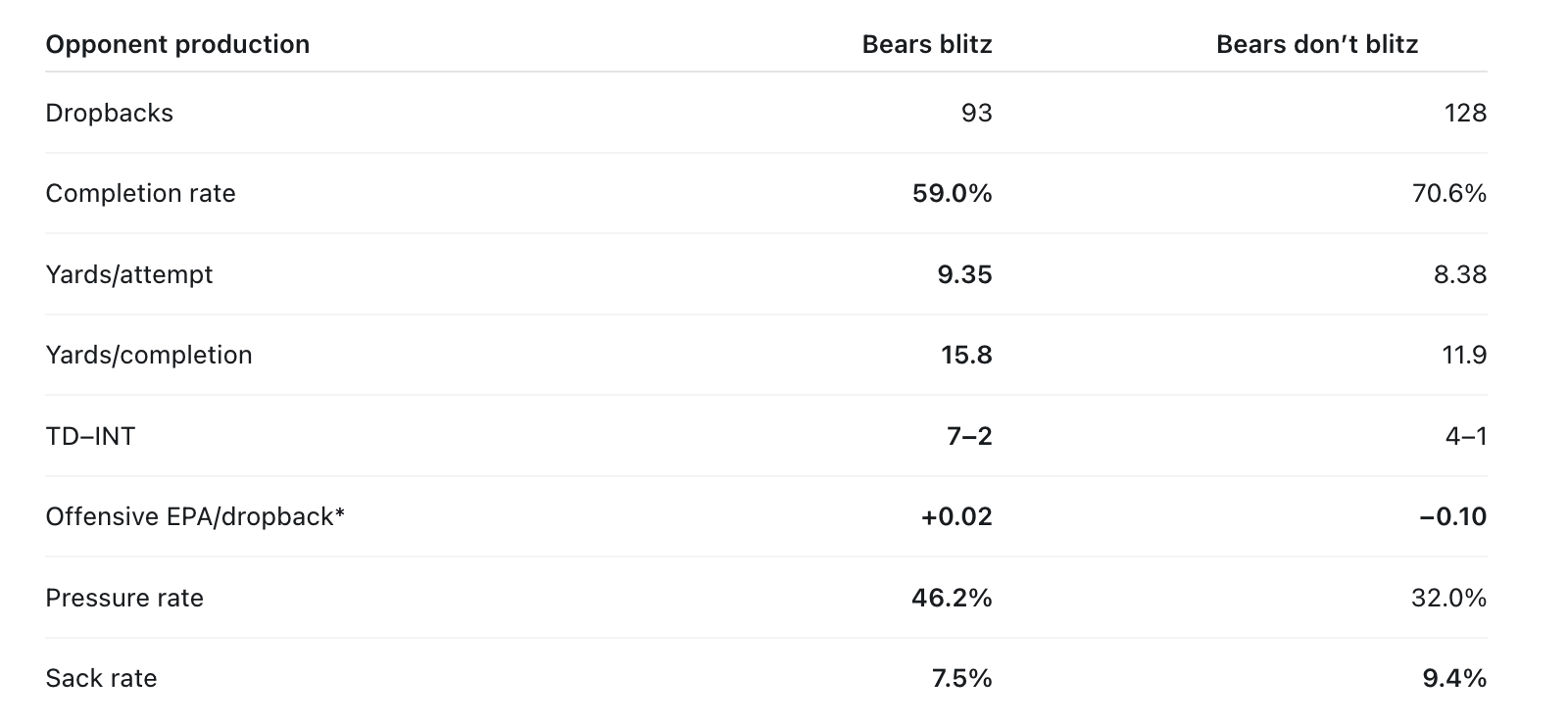
Although the Bears only allow 59% completions when they blitz, they’re allowing more yards per pass (9.35 to 8.38), per completion (15.8 to 11.9), and have a worse EPA per dropback compared to when they don’t blitz. Chicago has allowed seven of the 11 passing touchdowns against their defense when they blitz.
When the Bears get pressure, they have the seventh-worst pass defense in the NFL this season. When they DON’T get pressure, they have the best!
It’s still not good, because they didn’t get pressure, but somehow Chicago has had the least amount of damage done against them without pressure. When they blitz, they’re mediocre unless they finish—which this season has not been often enough for Allen to feel good about long-term job security.
The Matter of Matchups
When it comes to Chicago’s inconsistent season, it is easiest and probably smartest to answer the question of “Well, who did they play that week?” The Bears defensive ranking is heavily weighted on the four good games they’ve played this season compared to the three bad games.
Carson Wentz+Geno Smith+Michael Penix+Jalen Hurts:
58% completions
160 passing yards per game
6.9 Y/A
89 passer rating
-43 EPA (negative is good for the defense)
11.7% sack rate
41.4% pressure rate
What we’re learning as the season progresses is that Wentz was probably not even the second-best quarterback in Vikings camp this year. The Eagles are 30th in net yards per pass attempt and have one of the worst offensive lines. Geno is Geno and Penix is still quite mysterious to me.
Although to that point, of the four combined passing touchdowns these quarterbacks had, two were by Penix in garbage time and one was by Geno in garbage time, so these numbers were even a lot worse than they appear.
Then there are three games in which the Bears defense performed at an unacceptable level for a defensive coordinator—especially in Chicago where defense is supposed to be king.
Mind your P’s and Qb’s, because the Bears allowed over 300 passing yards to the Patriots, Packers, and Panthers.
Drake Maye+Jordan Love+Bryce Young:
72.7% completions
349.7 passing yards per game
10.6 Y/A
122 passer rating
+31.3 EPA
5.5% sack rate
34.5% pressure rate
On a near-identical number of dropbacks (110 to 111), these three quarterbacks shredded Chicago’s defense. They were sacked at half the rate as the other four teams and threw more than double the passing yards. They also shredded the blitz with these combined stats:
26-of-38 for 467 yards
12.3 yards/attempt
Four touchdowns, one interception
+0.47 EPA/dropback
For a defense to be good, they really have to be good always otherwise what’s the point? That team will eventually run into an offense in the playoffs that will beat them—it’s almost guaranteed. Compare Chicago’s uneven defense to Seattle’s this season and no quarterback has really been “good” against the Seahawks this year:

Marcus Mariota’s TD/INT ratio really oversells a bad day in which he was gifted too many short fields. Chicago’s game log shows much more consistency for quarterbacks that “if you’re good, you’ll be good”:

Sam Darnold has undeniably had consistent problems throughout his career when he’s under pressure. That’s where his bad throws and decisions come out, as we saw for one end zone interception against the Chiefs last week. (JSN has said it’s his fault, Darnold has insisted its his fault, which is the type of accountability you want to see out of players on either side.)
We’ll also have to keep an eye on Chicago’s usage of safeties. Per Next Gen Stats, teams have deployed two-high safeties against Darnold at a much higher rate than they did in 2025, which could be part of the reason he’s making more mistakes this season.
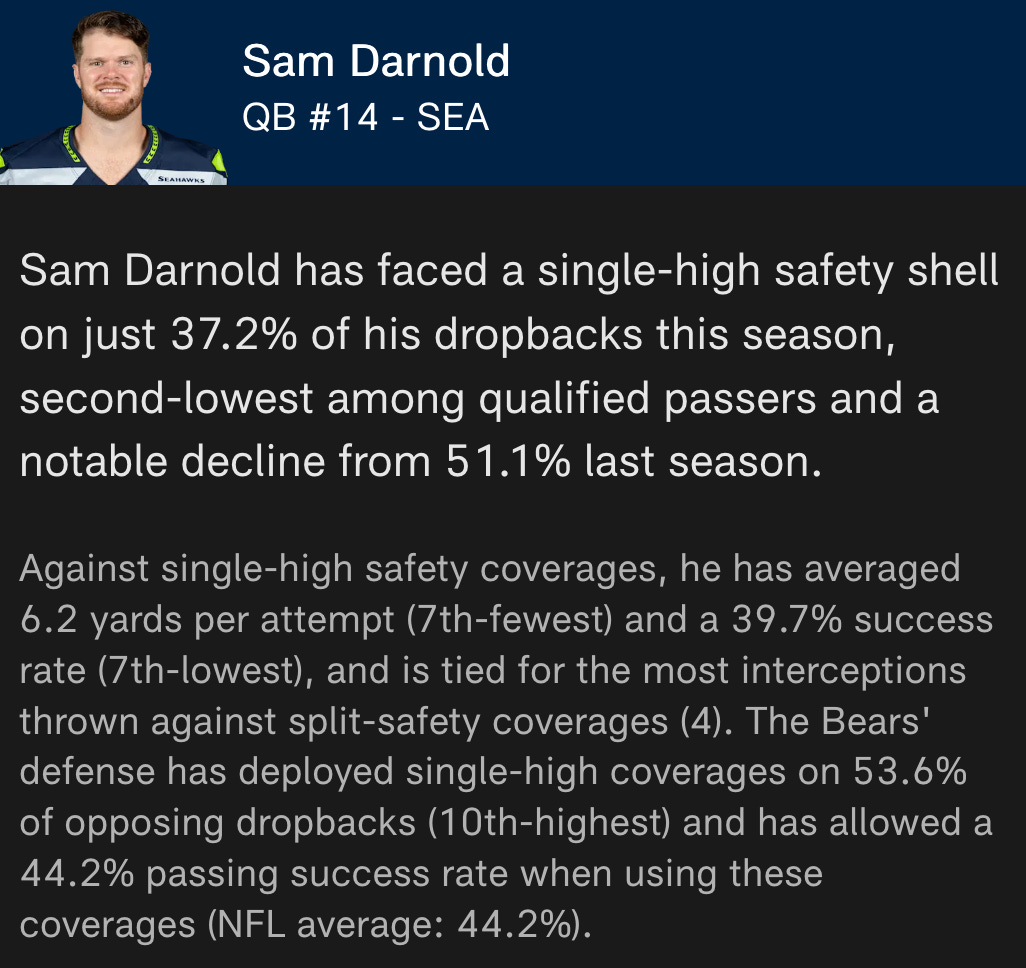
The loss of Coby Bryant in the preseason has led to the Bears using journeyman Cam Lewis, a converted cornerback, at free safety. Lewis is — perhaps — a liability in coverage and why better quarterbacks with more long distance range have had so much success against Chicago’s low-ranked secondary. Lewis is playing alongside rookie Dillon Thieneman, a highly-touted draft pick perhaps, but nonetheless inexperienced.

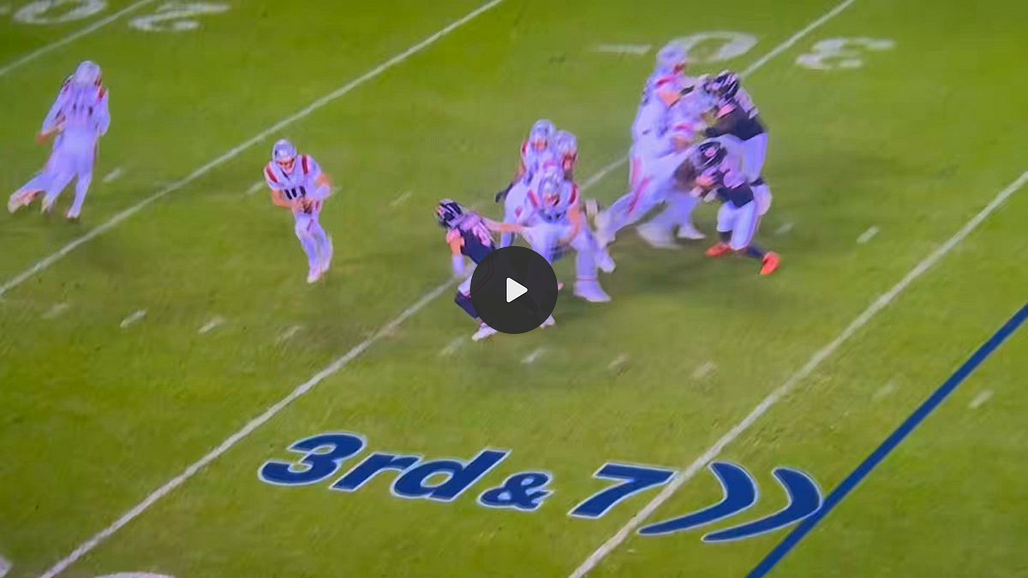
Which could explain why Allen is so dependent on a pass rush that gets home: The Bears are weaker in the secondary than they thought they’d be after investing in Bryant and Thieneman, they don’t have a corner capable of living alone on an island, so any strong-armed, accurate deep ball passer with a deep threat receiver should win a matchup with 2.5 seconds to throw.
For this week’s expectations survey, invest heavily in JSN.
For Sam Darnold’s stock, it’s a good time to buy low.
MM just had his press conference. Charbs will definitely get snaps, but it came off that he would be limited. Horton will “get his chance,” as Shaheed is out. Price could see playing time but as of the conference, he’s still just “designated to return,” and not yet active on the 53. There will be roster moves tomorrow that could lead to Prince on the roster and playing Monday.
I'm going to start waiting until Saturday to take the survey.